
L3 · Half the room
Rung L3: Half the room
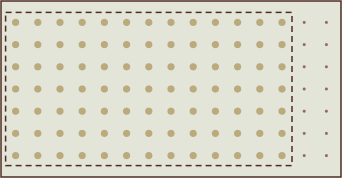
L3 is the first rung that is defined by a shape rather than by an amount. It covers a zone of roughly half an open room and leaves the far end genuinely unscented — which is a design decision, not an imbalance to be corrected.
By The Scent Desk·Published 2026-10-11
| Covers | 10–26 m2 |
|---|---|
| Readable at | 2–4.5 m |
| What it claims | A defined zone of scent covering roughly half an open room, with an unscented far end. |
| Where it applies | 10-26 m2; a six- to eight-reed diffuser, two plaques at opposite ends, or a diffuser plus a stone. |
| Typical rooms | Living room, open kitchen, a studio flat's main volume. |
| Air exchange | Needs the airflow to carry it. A single window opened twice a day is enough; a cross draught will shear the zone in half and leave you with two weak patches. Place the carrier on the downwind side of the room relative to where people sit. |
What you should notice
- One corner reads scented and the other does not — that is the intended shape of L3, not an imbalance to correct.
- It reads as too much in the first twenty minutes after the window closes — normal; it settles.
- It vanishes at the far end within an hour of opening a window — the zone is being stripped; move the carrier further from the opening.
How to adjust it
Do not increase reed count past eight. Add distribution instead: a second carrier at the far end at half the output.
If it overshoots — Two eight-reed diffusers in one 16 m2 room. Halve one of them by removing reeds; do not remove a whole carrier, or the zone collapses.
If it reads sharp — The carrier sits in the direct path of a desk fan or under an air-conditioning outlet. Move it out of the airstream; directed air turns an even zone into a hot spot.
L3 is a shape, not a concentration
L3's detection distance is 2.0 to 4.5 m over 10 to 26 m2, and its definition carries a condition that is easy to miss: the far end stays unscented. An even fill across the whole room is L4. What L3 buys is a boundary.
Scent with a boundary gives a direction. Entering, walking closer, moving away — the read changes continuously along that line, and that is what "a scented room" feels like. An even concentration habituates completely within ten minutes, and the end state is that nobody can smell anything at all.
Rooms and set-ups
| Room | Area | Set-up |
|---|---|---|
| Living room | 18-24 m2 | Eight 4 mm reeds in 200 ml |
| Open kitchen | 12-18 m2 | Seven 4 mm reeds in 180 ml |
| Studio main volume | 20-28 m2 | Split across two positions, four reeds each |
Eight 4 mm reeds is the ceiling. Nine or more pushes the room into L4, and L4 only works where a room keeps turning its air over. With the windows shut for the evening, an L4 set-up saturates in two hours and reads flat and heavy by four.
Position decides the shape
Two parameters decide whether L3 works: which side of the room, and how high.
- Downwind. Put the carrier where the air goes after it comes in. Upwind, molecules are pushed across the whole room the moment they leave the reeds and arrive diluted to nothing — the result is a uniform faintness with no shape at all.
- 1.2 m. The top of the seated breathing band. Below 0.8 m the zone hugs the floor, so people standing find it sharp while people sitting cannot find it. Above 1.6 m warm air lifts it toward the ceiling.
Keep 1.5 m clear of an air-conditioning outlet. Directed air slices an even zone into one sharp hot spot and one dead area, which is a distribution problem — and adding reeds only makes the hot spot hotter.
Failure signs
| Sign | Cause | Adjustment |
|---|---|---|
| Nothing at the far end | L3 working as specified | If you want full coverage, use the room's L4 plan |
| One side strong, one weak | Carrier upwind, or in front of a vent | Move it downwind, out of the airstream |
| Gone an hour after opening a window | Carrier within 1.8 m of the opening and being extracted | Keep 1.8 m clear of the window |
| Flat and structureless | A sealed room has saturated | Open a window for ten minutes; do not add oil |
Common misconceptions
Treating L3 as a louder L2. The difference between them is distribution, not quantity. Four reeds correctly placed in a 26 m2 living room will read better than eight placed badly.
Chasing evenness. Evenness is the L4 goal, and L4 requires continuous air exchange. Chasing it in a living room that opens its window once or twice a day produces saturation instead.
Trying to move up a rung by choosing a stronger scent. Scent direction answers what it smells like. Position and reed count answer how much, and where.
Failure diagnosis
| What you notice | What caused it | What to change |
|---|---|---|
| The far end of the room is completely unscented | L3 working as designed. The unscented end is the point of the rung, not an imbalance to correct. | If you want the whole volume covered, move the room to its L4 plan. Adding units to an L3 set-up saturates the near half before the far half starts to read. |
| One side strong, one side weak | The carrier is upwind, or it is in front of an air-conditioning outlet that is slicing the zone in two | Move it downwind and out of the airstream. Adding reeds only makes the strong side stronger. |
| Gone within an hour of opening a window | The carrier is inside 1.8 m of the opening and is being extracted directly | Move it back past 1.8 m. L3 needs the room to turn its air over, but not through the carrier itself. |
Plans published at this rung
| Rooms | Carrier | One fill lasts | Running cost |
|---|---|---|---|
| Kitchen | Reed diffuser | 40 d | CNY 34 |
| Living room | Reed diffuser | 45 d | CNY 38 |
| Study | Scent plaque | 46 d | CNY 22 |
This record went live on 2026-10-11. Records dated later in the register are not listed anywhere on the site until their date arrives.