
BATH · 5.6 m2 · draughty
Bathroom
the wettest room, and the one that eats the most refills
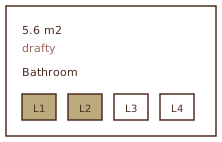
| Floor area | 5.6 m2 |
|---|---|
| Ceiling | 2.6 m |
| Air exchange | draughty extractor fan on a humidity sensor, small window |
| Door cycles | 2 / h |
| Working humidity | 72 % |
| Temperature swing | 8 C |
| Occupied | 35 min / day |
| Household | no pets or small children |
Room marks are generated at build time from this room’s own record: the rungs it is worked at, its floor area and its air class.
Why this carrier here
Relative humidity in a bathroom after a shower sits between 70% and 85% for roughly forty minutes. Water vapour competes with fragrance molecules for the same air, and then the extractor fan removes both. A carrier here needs a higher surface area or a higher loading to hold its line through that cycle.
The 5.6 m2 footprint is small enough that a single carrier can genuinely fill the room, so the temptation is to overshoot. In practice the correct rung for a bathroom is one step below what feels right in the shop, because the room is read at close range while damp.
Non-porous surfaces only. Unglazed ceramic, pressed cardboard and bare wood all take on water and go soft or mottled within a season.
Same room, other rung
| Rung | Covers | One fill lasts | Rung matrix |
|---|---|---|---|
| L1 | Barely there 1–5 m2 |
1-5 m2 of treated surface or enclosed volume; one sachet, one small plaque, two sprays on a cushion. | in preparation |
| L2 | Close range 3–12 m2 |
3-12 m2; one 40-60 g wax tablet, one 60-90 g plaque, a four-reed diffuser, or three sprays on upholstery. | A 92 g porous stone in a 5.6 m2 bathroom that runs at 72% humidity |
| L3 | Half the room 10–26 m2 |
10-26 m2; a six- to eight-reed diffuser, two plaques at opposite ends, or a diffuser plus a stone. | in preparation |
| L4 | Whole room 18–30 m2 |
18 m2 and up, or any open-plan volume; two eight-reed diffusers, a diffuser plus two stones, or a diffuser plus a textile pass. | in preparation |
1 live plan(s)
- A 92 g porous stone in a 5.6 m2 bathroom that runs at 72% humidity (L2 · 38 d · CNY 16)