
RD · Carrier register
Carrier dossier: Reed diffuser
The highest-output passive carrier there is, and the only one whose strength you can change without changing the bottle. This dossier covers how rattan actually draws, what the reed diameter does to the curve, which vessels survive which rooms, and how to clean a set without wrecking the next fill.
By The Scent Desk·Published 2026-08-27
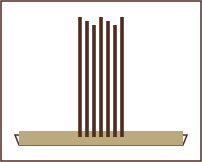
| Medium | solvent-based base liquid in a glass or ceramic vessel, 100-200 ml |
|---|---|
| Release mechanism | capillary draw up rattan or fibre reeds, evaporation only at the exposed reed surface |
| Where it wins | highest sustained output of any passive format, room-scale coverage, output tunable by reed count |
| Where it fails | spills if knocked, base liquid is flammable until evaporated, output declines as the reeds saturate |
| reed count | 4–10 |
| reed diameter mm | 3–5 |
| base volume ml | 100–200 |
| flip cycle days | 7–21 |
| release days | 45–120 |
| coverage m2 | 12–40 |
Capillary action is not a drinking straw
Rattan moves liquid by capillary action, but the mechanism is not the one the word "straw" suggests. The inside of a reed is a bundle of vascular channels running lengthwise; liquid climbs the fibre walls and then evaporates from the surface of the reed — including the lower section that sits above the liquid line. That means you can raise the release area by making the reeds longer as well as by adding more of them: the more reed stands above the liquid, the greater the output.
The practical consequence: with the same base liquid, 25 cm reeds release about 12% more than 20 cm reeds. Too long, though, and the upper section skins over into a dry shell that blocks the channel underneath it. Twenty-two to twenty-six centimetres is the useful window.
Reed diameter and reed count are two different knobs
- Diameter sets the maximum flow per reed. A 3 mm reed moves about 0.55 ml a day, a 4 mm about 0.85 ml, a 5 mm about 1.3 ml. Each extra millimetre of diameter adds roughly 55% to a single reed's output.
- Count sets the total. Each additional reed at the same diameter adds about 15% to the total rather than adding its share linearly, because the bottle mouth limits how much exposed surface the reeds can present without shading one another.
Do not turn both at once. Pick the diameter from the room size, then trim with count, where a single reed's 15% step is fine enough for any adjustment you will actually want to make.
Base liquid and vessel compatibility
| Vessel material | Fit | Note |
|---|---|---|
| Clear glass | Best | Level is visible; no reaction with the base |
| Glazed ceramic | Good | Light-blocking, but the level is hidden |
| Unglazed ceramic or bare plaster | Unsuitable | Wicks base through the wall; unusable within a month |
| Unsealed wooden tray | Unsuitable | Base soaks into the grain and leaves a permanent mark |
| Recycled dark glass | Acceptable | Some recycled glass has a micro-porous inner wall that stains over time |
The base liquid is flammable until it has evaporated. That is a property of the format, not a defect of any particular blend, and it is why nothing in this register ever sits within 30 cm of a burner.
Cleaning and switching direction
- Pull all reeds and throw them away. Saturated rattan cannot be cleaned; soaking only loosens the fibre.
- Pour out the remaining base, add warm water with a drop of neutral detergent, shake, pour away, and repeat twice.
- Rinse with warm water and invert to dry for at least 12 hours. Residual water dilutes the next fill and makes the output erratic for the first three days.
- When changing direction, wipe the bottle's thread with paper towel. Base liquid caught in the thread keeps releasing the old scent for days.
- Insert the new reeds and rebuild the output in stages — two or three first, the rest on day seven.
When not to choose it
- A room with a toddler or a pet where the carrier must stand below 1 m. The tip-over risk is not worth managing.
- Rooms with more than a 15 C temperature swing, such as a car or a sun room. Output swings too far to hold a stable read.
- Any situation needing scent immediately. Rattan takes six to twenty-four hours to reach steady state.
- Enclosed volumes where dose precision matters — wardrobes, drawers, cupboards. Even the smallest workable set-up, three reeds, is too strong below about 2 m2.
Sizing cheat sheet
| Room area | Diameter | Reeds | Base volume | Typical life |
|---|---|---|---|---|
| 3-5 m2 | 3 mm | 3 | 100 ml | 30 days |
| 5-10 m2 | 3.5 mm | 5 | 120 ml | 32 days |
| 10-18 m2 | 4 mm | 7 | 180 ml | 40 days |
| 18-28 m2 | 4 mm | 8 | 200 ml | 45 days |
Refill and replacement
Refill when the level drops below a third; replace reeds at the same time rather than reusing them, because saturated reeds stop drawing.
Plans using this carrier
| Rooms | Rung | One fill lasts | Running cost |
|---|---|---|---|
| Entryway | L1 | 32 d | CNY 21 |
| Kitchen | L3 | 40 d | CNY 34 |
| Living room | L3 | 45 d | CNY 38 |
Assembly, in order
- Fill the vessel — Pour 120 ml of base into a clean glass vessel and stop about 3 cm below the neck, so the reeds can stand upright instead of leaning on the rim.
- Load the reeds — Insert the reeds, wait thirty seconds, then invert the whole bundle once so the soaked ends point up. Flipping at the start roughly halves the time to the first readable scent.
- Wait out the first six hours — Leave the room alone for six hours. Output is unstable before that, and a judgement made in the first hour is wrong in the same direction every time.
- Flip on a 14-day cycle — Flip the bundle every fourteen days and move the outer reeds to the centre. Replace the entire bundle at ninety days; saturated rattan stops drawing.
- Top up below one third — Refill with the same base once the level falls below a third of the vessel. Never mix two directions in one vessel; the old one stays in the glass for weeks.