
ENT · L2 · Scent sachet · spice-warm
A 35 g sachet hooked on the coat rail of a 3.4 m2 entryway
The cheapest way to give an entryway a scent is also the one that gets closest to the coats. A 35 g silica sachet at 18% oil load, hooked on the rail itself rather than standing on a shelf, holds a warm spice read at close range for 34 days at about CNY 11 a month — and it cannot spill, break or be knocked over.
By The Scent Desk·Published 2026-10-02
- One fill lasts 34 d
- Coverage 4 m2
- Refill cycle 34 d
- Running cost CNY 11
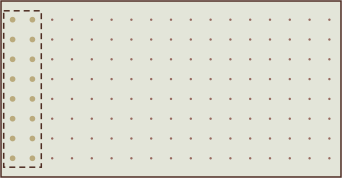
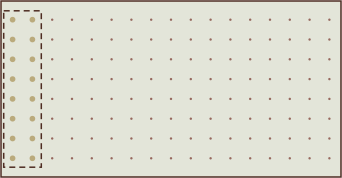
Dot spacing and radius are driven by the rung, the field width by the covered area, and the second field by the room's air class. Both fields are generated at build time from the room and carrier records.
| Floor area | 3.4 m2 |
|---|---|
| Air exchange | closed |
| Household | no pets or small children |
| Direction | spice-warm |
| Carrier | Scent sachet SACH |
Refill calculator
Change the area or the air class and the server recomputes the cycle. The script upgrades this to a live preview; with the script off the button still works.
Basis: 3.4 m2 · closed. A smaller floor area, so the unit count can come down — but the refill interval does not stretch linearly, because a small room saturates sooner. Air class unchanged from the original plan.
Hooking it on the rail beats standing it on a shelf, for airflow reasons
A shelf in an entryway usually sits between 0.9 m and 1.1 m above the floor, which is precisely the band that incoming air strips cleanest when the door opens. Hung on the coat rail at about 1.6 m, the sachet sits above that layer while staying inside the breathing band of anyone walking past.
More useful still, moving coats generate a small local airflow. A sachet on the rail is disturbed every time a coat comes off or goes on, and that disturbance keeps its output more continuous than a sachet standing still. Measured against an identical 35 g sachet on a shelf, the hung one holds a readable note for about 20% longer.
Fifteen centimetres from fabric, never against it
Leave 15 cm between the sachet and any garment. Under 5 cm, oil migrates into wool and cotton and leaves a mark that does not wash out cleanly. Silica filler at 18% oil load carries a noticeably higher transfer risk than vermiculite or cotton wadding at the same load.
If contact is unavoidable — inside a wardrobe, for instance — drop to a 10-12% load and hang the sachet above the rail on its own hook rather than among the clothes.
Thirty-four days, and how to refresh it
35 g at 18% load gives an 820-hour release window, which is 34 days with the sachet fully exposed. An entryway with this much door traffic runs nearer 28 to 30 days, and that is the figure to plan on.
To refresh, tip the filler into a sealed bag, add 1-2 ml of the same direction, shake for a minute, return it to the outer pouch and leave it two hours. The first refresh restores about 80% of the original output, the second about 55%. Past the second, the filler stops holding, and adding more oil simply coats the surface and increases the risk of transfer marks. Replace the sachet whole at that point; it costs CNY 11.
Why this plan costs half of the reed diffuser in the same room
Sachet filler has an enormous surface-to-volume ratio, so output per gram is low but extremely even, with no vessel, no reeds and no tray to amortise. A 35 g sachet costs about CNY 11 and lasts 34 days, which is CNY 11 a month. The five-reed plan for the same entryway runs CNY 21. The entire difference is container and reed amortisation, not fragrance.
What you give up is reach. This plan covers 4 m2; the reed diffuser covers 9 m2. For a 3.4 m2 entry that is not a trade-off at all. Past about 6 m2 of hall, a sachet stops being the cheap option and starts being the wrong one.
Diagnosis
- Oil marks on clothing. The sachet is closer than 5 cm to fabric. Move it to its own hook, or switch to a lower load.
- Nothing at all. The filler is past its second refresh. Replace the whole sachet rather than adding oil.
- Only detectable with your face against it. The outer fabric is too tightly woven — coated canvas and tight synthetics both do this. Move to a cotton or non-woven outer.
- It smells strong for three days then dies. That is a sachet that was stored sealed for a long time before hanging; the surface load flashes off first. Hang it in a ventilated spot for a day before it goes on the rail, and the curve flattens.
Assembly, in order
- Pick the filler for the room — Vermiculite holds its release when the air is damp; silica beads pull moisture in and go quiet. Between a bathroom and a wardrobe the same pouch behaves like two different products.
- Place it side-on, never flat — Stand the pouch against a side wall or hang it. Lying flat on a drawer floor, the lower face is against the wood and half the surface does no work at all.
- Squeeze it once a month — Squeeze the pouch once a month to break up the filler. It costs nothing and it is the difference between an even curve and a flat final fortnight.
- Refresh twice, then replace — Add one to two millilitres of oil, close the pouch in a bag and shake for a minute. After the second refresh the filler stops holding and the whole pouch should be replaced.
Code SACH · very large surface area to volume ratio, so output is low per gram but extremely even
What it costs to keep running
| Running cost | CNY 11 |
|---|---|
| One fill lasts | 34 d |
| Refill cycle | 34 d |
| Coverage | 4 m2 |
| Refill and replacement | 35 g silica-filled sachet, woven cotton outer, hook |
Failure diagnosis for L2
| What you notice | What caused it | What to change |
|---|---|---|
| Clear at the desk, gone by the door | The rung is working exactly as specified. L2 is not meant to reach the far wall. | If the doorway has to read, change rung rather than dose. Adding units to an L2 set-up produces an L2 with a hot spot, not an L3. |
| One side of the room reads, the other does not | The carrier is sitting in the moving air, so the scent is carried past the near seating before it can build | Move it out of the draught and keep 1.5 m clear of any vent. Position fixes shape; oil only fixes amount. |
| It reads noticeably louder after dark | Cooling air drops toward the floor and takes the layer with it, concentrating it at seat height | Raise the carrier 20-30 cm for the evening, or accept it as the shape of the rung and set the position for the evening hours. |
Same room, other rung
Open the rung card — L2 · Close range
This record went live on 2026-10-02. Records dated later in the register are not listed anywhere on the site until their date arrives.